Why is nickel-based alloy C276 called the “King of Universal Corrosion Resistance”?
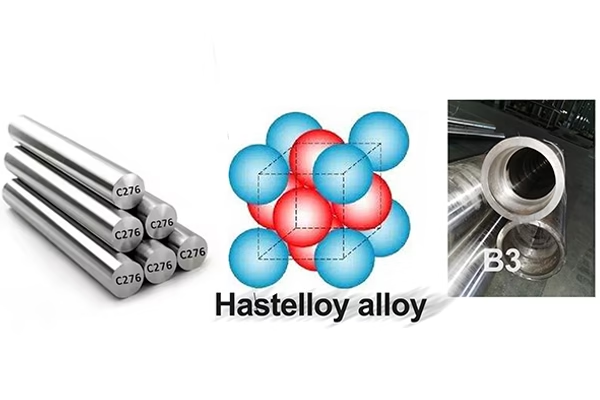
The title of “universal corrosion-resistant alloy” for nickel-based alloy C276 (UNS N10276) is no accident. Its secret lies in its precisely proportioned multi-component system—57% nickel forms the matrix, providing a foundation for corrosion resistance; 16% chromium forms a protective film in oxidizing environments; 16% molybdenum strengthens resistance to reducing media; and 4% tungsten enhances localized corrosion resistance. Furthermore, impurities such as carbon and silicon are controlled at levels below 0.01% and 0.08%, respectively, thereby fundamentally reducing the risk of intergranular corrosion after welding.
This compositional design provides comprehensive corrosion resistance: it can withstand aggressive media such as boiling hydrochloric acid and wet chlorine gas, and maintains stable performance over an ultra-wide temperature range of -200℃ to 1090℃. Its pitting resistance equivalent (PREN) value is as high as 55, far exceeding the 25 of 316L stainless steel. This means that in harsh environments containing chloride ions, it can effectively inhibit pitting corrosion, crevice corrosion, and other potential problems.
What are the main differences between nickel-based alloy C276 and the commonly used industrial 316L stainless steel? Mainly three aspects:
1. Superior Corrosion Resistance
In hydrochloric acid, C276’s corrosion resistance is 72 times that of 316L. Experiments show that in 20% hydrochloric acid at 100℃, the annual corrosion rate of C276 is less than 0.1mm, while 316L would have already been severely damaged under this environment.
2. Service Life
In high-stress environments containing chloride ions, the service life of C276 can be more than 100 times that of 316L. In the saturated brine environment of the chlor-alkali industry, 316L equipment requires frequent replacement, while C276 pipes have an annual corrosion rate of only 0.03mm and a lifespan easily exceeding 10 years.
3. Leading Mechanical Properties
Its load-bearing capacity is nearly twice that of stainless steel, its room-temperature tensile strength reaches 850 MPa, and its elongation exceeds 40%. Even at 650℃ and 200MPa stress, the creep deformation after 1000 hours is only 0.15%, balancing both corrosion resistance and load-bearing capacity.

Applications Across All Scenarios, from Chemicals to Semiconductors
With 60 years of proven reliability, C276 has become the “standard material” in many highly corrosive industries:
- Chemical Industry: In hydrofluoric acid concentration towers in the fluorochemical industry, it can withstand HF gas corrosion at 150℃, with a service life of over 15 years, three times that of other alloys; after adopting C276 in the evaporator of the sulfuric acid concentration system, the maintenance cycle is extended to over 5 years.
- Environmental Protection and Energy: Equipment such as boiler chimneys and flue gas desulfurization scrubbers comes into contact with sulfur compounds and chloride ions. Linings and pipes made of C276 effectively resist corrosion, reducing equipment failure rates.
- High-End Manufacturing: The corrosive gas environment in semiconductor etching processes places stringent demands on materials. Due to its excellent resistance to fluoride ion corrosion, C276 has become the preferred material for key components of etching equipment.
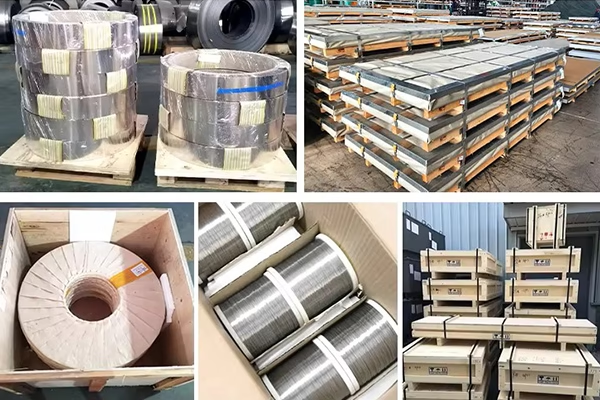
From basic chemical reaction vessels to cutting-edge semiconductor equipment, C276 has proven, over half a century of practice, that in extremely corrosive environments it is not an “alternative solution,” but the “ultimate answer.” For more questions about nickel-based products, please contact Tiny Alloy