In harsh industries such as chemical processing, oil and gas, offshore engineering, and flue-gas desulfurization, equipment failure is rarely caused by insufficient strength. Most failures start with pitting, crevice, or intergranular corrosion silently attacking the metal. For engineers and buyers selecting high-performance alloys, understanding the PREN of Alloy 825 (UNS N08825) is one of the most important steps to ensure long-term reliability.
In this article, we explain clearly, from the PREN value, why Alloy 825 (UNS N08825) remains stable in aggressive environments and has become one of the most widely used nickel-based corrosion-resistant alloys worldwide.
I. What Is PREN, and Why Does It Matter?
PREN — short for Pitting Resistance Equivalent Number — is the internationally recognized index that measures how well an alloy resists chloride-induced pitting and crevice corrosion. The formula is widely used across the metal industry:PREN = %Cr + 3.3 × %Mo + 16 × %N
The higher the PREN:
- The stronger the resistance to chloride-induced pitting
- The better the protection against crevice corrosion
- The more stable in seawater, acids, and salt-rich environments
Simply put: The higher the PREN, the less likely the alloy is to corrode and pit. The PREN of Alloy 825 (UNS N08825) typically reaches above 32 when produced with controlled, standard-compliant chemistry. It is a performance threshold that directly separates high-quality alloys from low-grade alternatives.
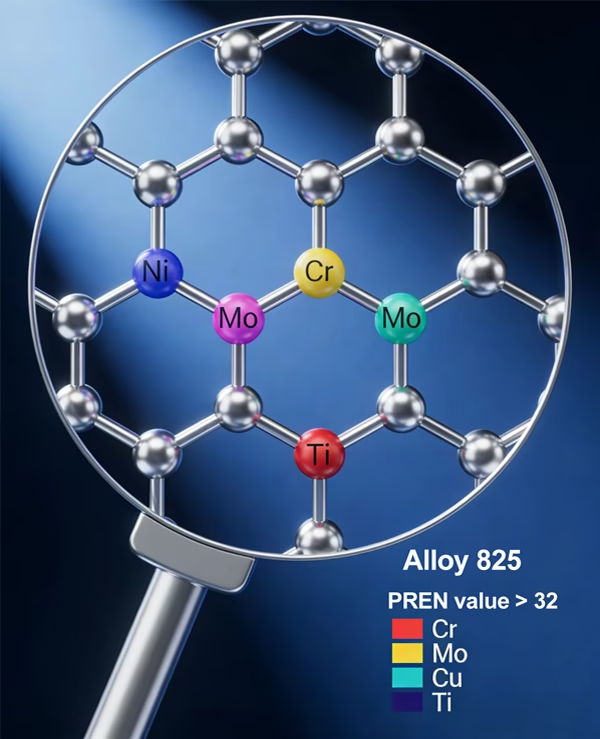
II. Why is the PREN of Incoloy 825 stable at >32?
The typical composition of Alloy 825 (UNS N08825) is: Ni ≈ 42%, Cr ≈ 22%, Mo ≈ 3%, Cu ≈ 2%, Ti ≈ 0.8%. Substituting these into the PREN formula: PREN = %Cr + 3.3 × %Mo + (16 × %N≈0), we get: PREN ≈ 22 + 3.3 × 3 + 16 × 0.02 = 32.22. (The nitrogen (N) content in Incoloy 825 alloy is typically specified as ≤ 0.20%, with actual values often being significantly lower than this.)
This explains why, as long as the composition meets the standards, the PREN of Alloy 825 will naturally and consistently exceed 32.
In real-world working conditions, this means excellent performance in both oxidizing and reducing environments, outstanding resistance to intergranular corrosion, and minimal risk of pitting even in aggressive media.
Chemical Composition of Alloy 825 (UNS N08825) (wt%)
| Element | Min. | Max. | Typical Value | Typical Function |
| Nickel (Ni) | 38.0 | 46.0 | ~42% | Alloy matrix, improves toughness and stress corrosion cracking resistance, enhances overall corrosion resistance |
| Chromium (Cr) | 19.5 | 23.5 | ~21.5% | Forms a stable passive film, improves oxidation corrosion resistance, one of the core elements contributing to PREN value |
| Iron (Fe) | Balance | Balance | ≥22% | Reduces alloy cost, assists in improving mechanical properties and processability |
| Molybdenum (Mo) | 2.5 | 3.5 | ~3.0% | Enhances pitting and crevice corrosion resistance, improves reducing acid corrosion resistance, significantly increases PREN value |
| Copper (Cu) | 1.5 | 3.0 | ~2.0% | Improves corrosion resistance to reducing acids such as sulfuric acid and phosphoric acid, assists in enhancing overall corrosion performance |
| Titanium (Ti) | 0.6 | 1.2 | ~0.8% | Stabilizing element, prevents alloy sensitization, avoids intergranular corrosion, and ensures stable corrosion resistance after welding |
| Carbon (C) | — | 0.05 | ≤0.025% | Controlled at low content to avoid carbide formation, prevent intergranular corrosion, and ensure corrosion resistance |
| Manganese (Mn) | — | 1.0 | ≤1.0% | Improves smelting and processing properties of the alloy, assists in deoxidation |
| Silicon (Si) | — | 0.5 | ≤0.5% | Deoxidizes during smelting, a small amount of silicon can improve oxidation resistance |
| Aluminum (Al) | — | 0.2 | ≤0.2% | Assists in deoxidation, a small amount of aluminum can improve high-temperature oxidation resistance |
| Cobalt (Co) | — | 1.0 | ≤1.0% | Impurity element, controlled at low content to avoid affecting alloy corrosion resistance and mechanical properties |
| Phosphorus (P) | — | 0.03 | ≤0.03% | Harmful impurity, strictly control content to prevent alloy embrittlement and avoid reducing corrosion resistance |
| Sulfur (S) | — | 0.03 | ≤0.015% | Harmful impurity, controlled at extremely low content to prevent hot working embrittlement and ensure processability and corrosion resistance |
III. What does PREN > 32 mean? Real-world comparison
In hydrochloric acid, sulfuric acid, chlorine-containing flue gas, and seawater environments:
316L quickly develops pitting and perforation.
Alloy 825 maintains stable passivation.
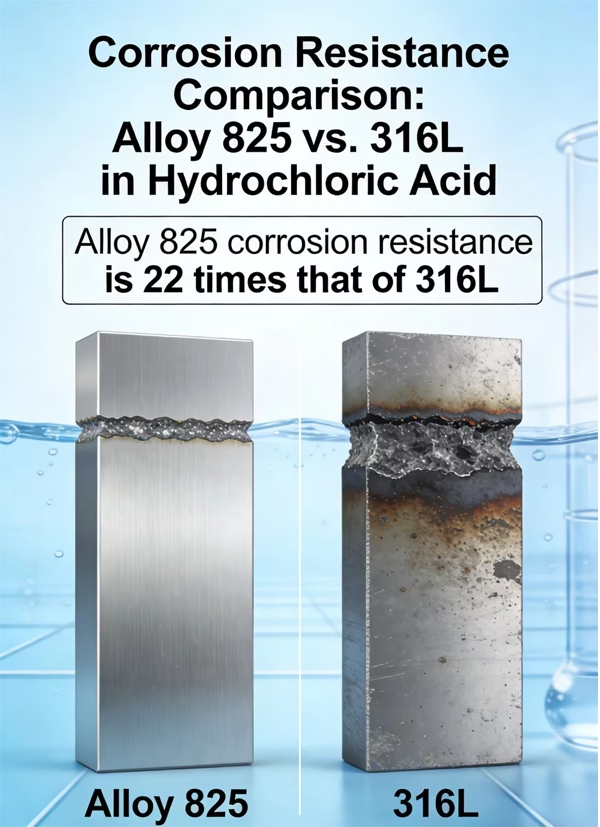
Actual test data show that our Alloy 825 has 22 TIMES the corrosion resistance of 316L in hydrochloric acid environments.
This is the real difference brought about by PREN: ordinary stainless steel can only “barely resist corrosion,” while 825 alloy is “long-term corrosion resistant.”
IV. Why can’t all 825 alloys guarantee a PREN > 32?
Theoretically, a PREN > 32 is easily achievable, but in practice, it depends on the manufacturer’s control over the content of key elements (such as chromium and molybdenum):
Reputable manufacturers: Cr and Mo are controlled at the upper limit of the standard, resulting in uniform composition and a stable PREN > 32.
Low-cost manufacturers: Cr and Mo are controlled at the lower limit, or even scrap is recycled, potentially causing the PREN to drop below 30.
Substandard PREN directly results in: premature pitting corrosion, significantly shortened equipment lifespan, and dramatically increased downtime, maintenance, and replacement costs.
Our TINY ALLOY Alloy 825 (UNS N08825) employs strict composition control, professional melting processes, and comprehensive spectrometer testing. We ensure that every batch of Alloy 825 (UNS N08825) has a stable PREN value above 32 and provide a complete factory test certificate (MTC).
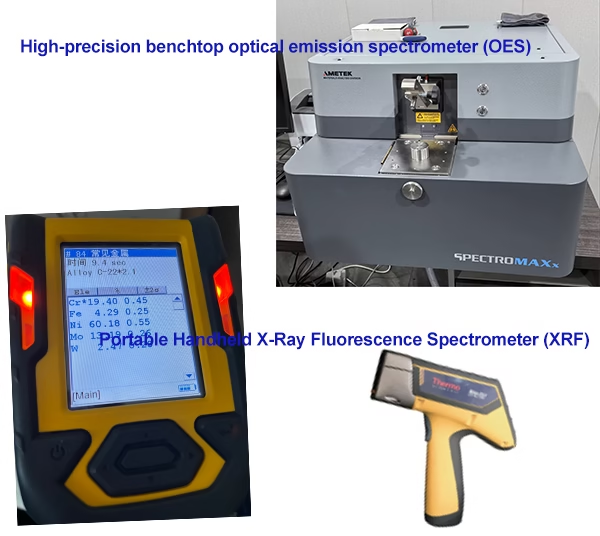
More equipment for quality control, please click page ABOUT US -Quality Control.
If you are looking for a reliable and corrosion-resistant alloy for critical components, the PREN value of Alloy 825 (UNS N08825) provides everything you need. Choosing PREN > 32 ensures longer equipment life, safer operation, and lower overall costs.
For product inquiries and technical discussions, please contact Tiny Alloy.